
How I Stopped Losing Track of Side Project Ideas
I’ve been using Claude Code and Codex a lot lately, and something unexpected happened: I started having more ideas than I could track.
Not because I’m suddenly more creative. Because building stuff got faster. When you can go from “I wonder if…” to a working prototype in an afternoon, you start noticing more itches worth scratching. A dashboard for ski conditions. A break-even calculator for EV charging. A CLI for searching mountain peaks.
A lot of these are afternoon builds. Some would take weeks. A few will never happen. But I kept losing them, scattered across Notion pages, random notes, half-remembered thoughts.
Where Ideas Went to Die
I had a system, but it was fragmented. Some notes in Notion, some in my head, some as random GitHub issues scattered across repos. No single place to look.
I like to keep my brain tidy. Offload things to a dedicated place so I’m not carrying them around. But my “dedicated place” was really five different places, none of which talked to each other.
Why GitHub Issues
Since I’m already living in a GitHub + Claude Code world, I figured: why not keep ideas where I already work?
Coding agents can access GitHub directly. I can point Claude at an issue and say “brainstorm this with me,” and it has full context. Sure, there’s a Notion MCP, but it doesn’t work well with Claude Code on the web or other async workflows I use on the go.
This website lives on GitHub Pages, so ideas live in the same repo where I’ll eventually publish posts about them. Keeps the pipeline in one place.
And issues have just enough structure (labels, checklists, comments, close/open states) without becoming a project management tool.
The “Itch & Pitch” Template
After a few rapid iterations, I ended up with a GitHub Issue template that forces me to think through an idea before I start coding:
## The Itch (Why?)
What sparked this? What's annoying you?

## The Pitch (What?)
One or two sentences describing what you're building.

## The Destiny (Who?)
- [ ] Just Me (Localhost/Scripts)
- [ ] Friends & Family (Shared link/Group chat)
- [ ] The World (Public launch/Blog post/Portfolio)

## The Playground (Fun/Tech)
What new tools are you exploring with this?

## AI Brainstorming Context
Core constraints, rabbit holes to avoid, success criteria.
The template is mostly settled, but I’m still experimenting with the “AI Brainstorming Context” section. I use Obra’s superpowers brainstorming skill, which picks up context from the issue and steers the conversation in the right direction. No more “let me suggest a Kubernetes cluster for your weekend project.”
Example: EV Break-Even Calculator
I recently built an EV vs gas break-even calculator after a conversation with my dad at a charging station. The issue looked like this:
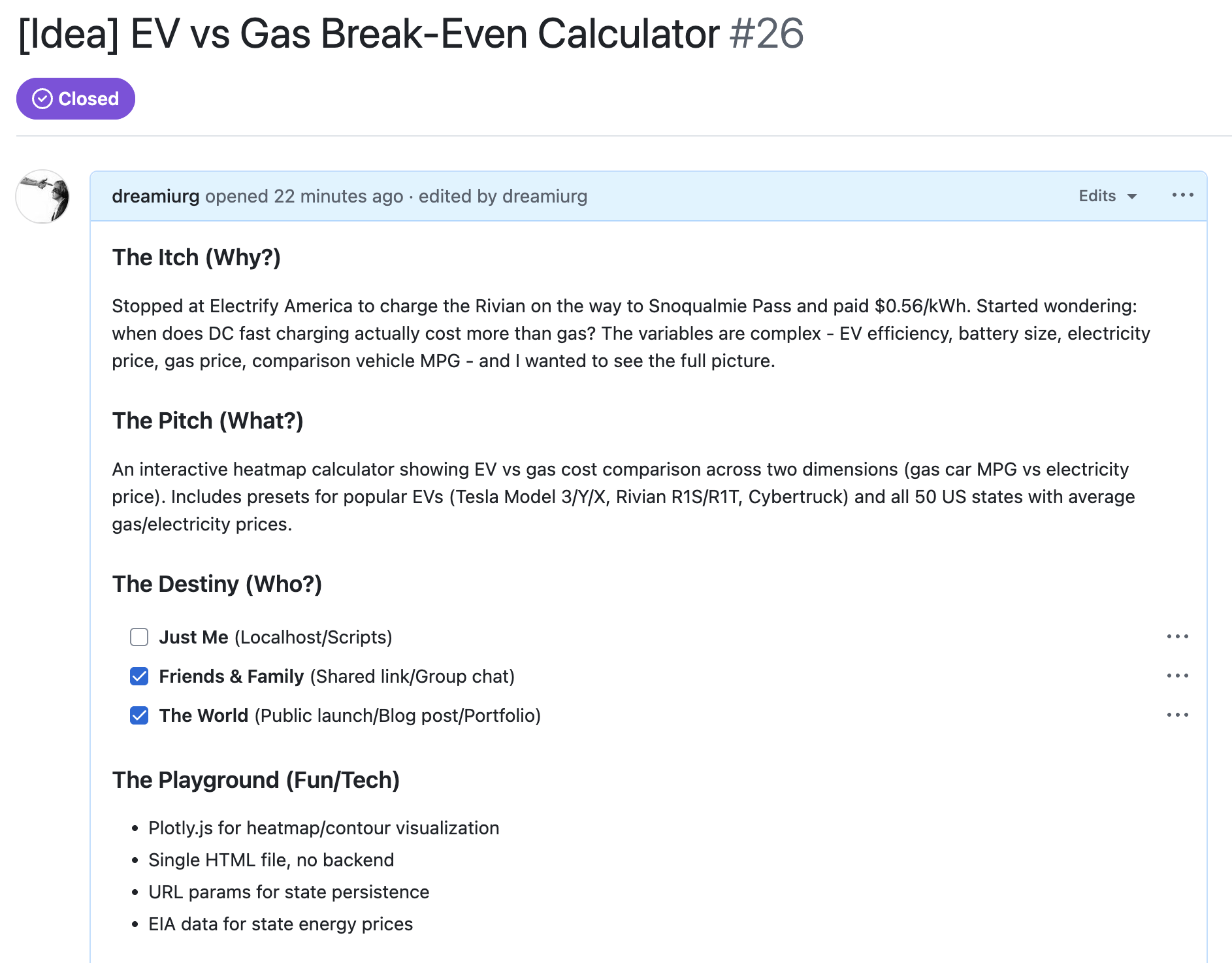
I paid $0.56/kWh at a DC fast charger and started wondering about the break-even point compared to gas. Wanted a mental model for when EV charging is actually cheaper.
The “Destiny” checkboxes helped me scope it. This wasn’t just for me, I wanted to share it publicly, which meant building something polished enough for a blog post.
The playground section reminded me I wanted to try Plotly.js for visualization. Single HTML file, no backend.
90 minutes later: published calculator, blog post, issue closed.
From Idea to Blog Post
Open Claude Code in a new session on this repo. Tell it to file a new issue using the template. This seeds the context with the Itch & Pitch structure.
Then I ask Claude to brainstorm using superpowers. The brainstorming skill picks up the constraints from the issue and keeps things focused. From there I can track the work, build, ship, and publish.
I also leave comments on the GitHub issue as I go, notes for future enhancements, or food for thought when writing the blog post later.
Will This Stick?
Honestly? I don’t know. I’ve been using this for a few weeks and it’s working well. Having ideas in one AI-accessible place feels like the right foundation. But I’ve also abandoned plenty of “systems” before.
What I do know: the friction between “random idea” and “thing I can actually work on” dropped significantly. And that’s worth something.
The template is available as a gist if you want to steal it.
Related: I wrote about where the work actually goes when you’re building with AI agents — the workflow that makes these quick builds possible.
Cheers.
Comments